
CCAT Funding Opportunity (Request for Proposal)
Document Links
Total Available Federal Funding: $2.0M
Issue Date: October 1, 2026
Proposal Due Date: November 12, 2026
For questions, please contact Henry Liu (CCAT Director) and Debby Bezzina (CCAT Managing Director)
Overview of CCAT
The University of Michigan at Ann Arbor, in partnership with Central State University, Purdue University, University of Akron, University of Illinois at Urbana-Champaign, and Washtenaw Community College, established the USDOT Region 5 University Transportation Center (UTC): Center for Connected and Automated Transportation (CCAT) in 2016 under the funding support from the FAST ACT. In 2023, CCAT was renewed under the support from the Bipartisan Infrastructure Law (BIL), with an expanded consortium adding Northwestern University, University of Minnesota, Twin Cities, and University of Wisconsin at Madison.
The statutory research priority area that CCAT addresses is Promoting Safety. Under BIL, CCAT is USDOT’s designated UTC “focusing its efforts in the field of comprehensive transportation safety, congestion, connected vehicles, connected infrastructure, and autonomous vehicles, including the cybersecurity implications of technologies relating to connected vehicles, connected infrastructure, and autonomous vehicles.”
CCAT Vision: Provide regional and national leadership in connected and automated transportation system research, education, and training.
CCAT Mission: Significantly advance the evolution of the U.S. next-generation transportation systems with connected and automated vehicles and infrastructure.
Alignment with USDOT Priorities
Proposals submitted to this Year 2027 funding opportunity should be aligned with current U.S. Department of Transportation (USDOT) priorities. In developing project scopes, proposers are strongly encouraged to review and demonstrate relevance to the following four source documents:
- Secretary Duffy’s Surface Transportation Reauthorization (STR) Letter to Congress (July 22, 2026). Secretary of Transportation Sean P. Duffy’s letter to the Chairs and Ranking Members of the Senate Committees on Environment and Public Works, Commerce, Science, and Transportation, and Banking, Housing, and Urban Affairs outlines the Administration’s top surface transportation reauthorization priorities, including transit safety and security, safe automated vehicle (AV) innovation, railway safety, expanding and modernizing infrastructure (including digital infrastructure), Highway Trust Fund solvency, and commercial motor vehicle enforcement. A public-facing summary of the letter is available from Holland & Knight: “DOT Secretary Duffy Reiterates Surface Transportation Reauthorization Priorities” (July 2026).
- U.S. DOT Strategic Plan, FY 2026–2030. The Department’s Strategic Plan establishes four strategic goals — Safety, Infrastructure, Innovation, and Efficiency — and associated strategic objectives (e.g., improving aviation and surface transportation safety, accelerating project delivery, reducing regulatory burden, and enabling transportation technology development and adoption, including artificial intelligence and automated vehicles). Public link: U.S. DOT Strategic Plan for FY 2026–2030 (transportation.gov) | Full PDF
- OST-R Interstate Digital Corridors (IDC) Initiative — Call to Action for UTCs. The Office of the Assistant Secretary for Research and Technology (OST-R), together with FHWA and Anchor State DOTs, has called on University Transportation Centers to align existing and planned research with the IDC Initiative’s focus on real-time data sharing for work zones, lane closures, and dynamic operational conditions, and to report progress to USDOT and their State DOT partners. Related public resources: FHWA EDC-8 Connected Corridors and the ITS America Digital Corridors Initiative (DCI) Coalition (the OST-R Interstate Digital Corridors Initiative one-pager presented at the CUTC Summer Meeting, June 16, 2026, is available from CCAT upon request).
- National Roadway Safety Strategy (NRSS) 2026.
Emphasized/added for 2026:- Intelligent Transportation Systems
- Management and Operations
- Vehicle Tech
- AV/ADS
- Commercial Vehicle Compliance (NETS)
- Modernization of crash test dummies
- Continued monitoring of FMVSS
- Updating CAFÉ standards
- Performance based safety (e.g. Mcity AV Safety Assessment)
- Safety for children and families (e.g. illegal school bus passing)
- Tribal and rural safety
De-emphasized/removed for 2026: - Safer speeds removed as a core tenet
- Automated traffic enforcement removed
- Impaired driving removed
- Less emphasis on multimodal
- Less emphasis on VRU
Related public resources: https://www.transportation.gov/sites/dot.gov/files/2026-08/USDOT-National- Roadway-Safety-Strategy-2026.pdf
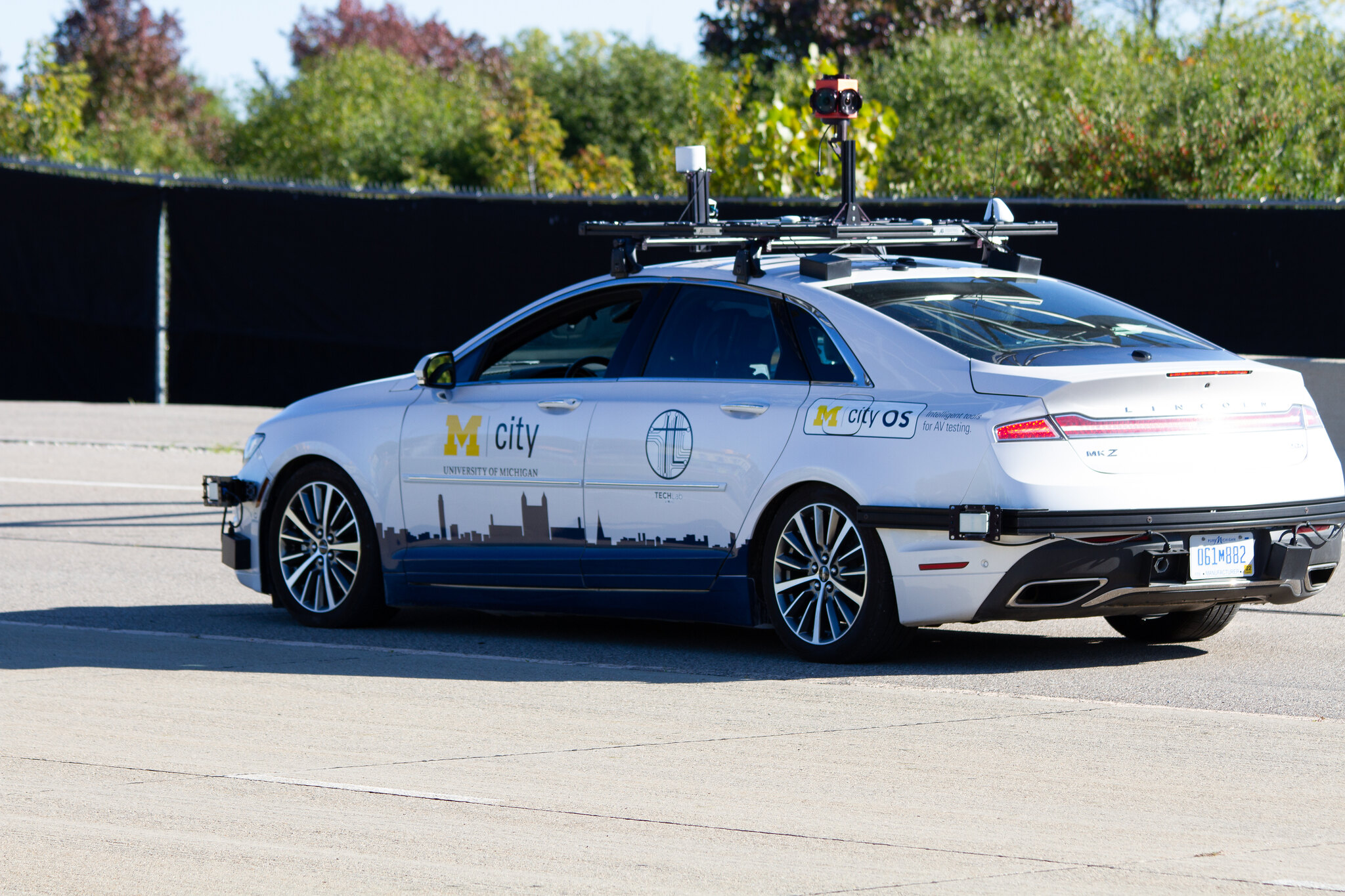
As described in Proposal Submission Instructions below, CCAT will evaluate proposals in part on how clearly they articulate alignment with these USDOT priorities. CCAT invites proposals from the community of researchers within the partner institutions. CCAT seeks both fundamental and applied research proposals that align with the CCAT mission. CCAT particularly values proposals with demonstrable outcomes or significant impacts on the field or state-of-the-practice. Additionally, CCAT encourages researchers to utilize the Mcity 2.0, a remote-accessible mixed reality test facility designed for connected and automated vehicles and infrastructure. Mcity 2.0 is funded by the National Science Foundation and will provide funding for researchers to use the test facility. For information regarding the research use cases supported by Mcity and how to make the request to use the facility, please visit: https://mcity.umich.edu/what-we-do/mcity-test-facility/remote-access/.
Funding Opportunity Description
Connected and automated vehicle (CAV) technologies hold the potential to substantially improve traffic safety and mitigate traffic congestion. As CAV technologies progress towards integration into public roadway systems, there exist a variety of open questions and issues on technology development, policy and planning, and system design and operations that require answers and resolution.
To address these questions, CCAT has created working groups to focus on four research thrusts: (1) advancing safety through accelerated training and testing of CAV and vehicle- to-everything (V2X) deployment, (2) enhancing mobility by developing connected infrastructure and cooperative driving automation, (3) hardening the CAV ecosystem to reduce cybersecurity risks, and (4) leveraging CAV and infrastructure to enhance transportation accessibility.
Across all four thrusts, CCAT is particularly interested in research that strengthens regional economic competitiveness. By improving mobility for non-drivers, older adults, people with disabilities, and other populations, connected and automated transportation systems can expand access to employment, education, healthcare, entertainment, and other essential services — helping to increase workforce participation, support economic activity, and improve quality of life in the communities CCAT serves.
The following research topics are identified by the CCAT Work Groups, the CCAT Technical Advisory Board (TAB), and the CCAT Academic Steering Committee (ASC). However, the following list of topics is not meant to be an exhaustive list. Instead, CCAT is actively seeking proposals that present innovative concepts capable of expediting the progress and implementation of connected and automated transportation systems, with the aim of advancing safety, improving mobility, strengthening cybersecurity, and promoting accessibility.
This year CCAT highly encourages proposals that build upon the achievements of previously funded projects (not exclusively limited to previously funded CCAT projects). We are particularly interested in the demonstration or implementation projects that are based on previous research results. As this year is the 5th year of the existing agreement, CCAT is soliciting one-year projects that will have a tangible scope that will produce direct and noteworthy results.
Thrust 1: Advancing CAV Safety.
Safety is and always will be the top priority for our roadways in the United States. Connected and automated vehicle and infrastructure technologies and systems have the potential to improve safety. Example ideas from the CCAT Working Groups, TAB, and ASC are listed in the following:
- Interpreting road-worker hand signals and hand-carried work zone signs. Deployment experience suggests AVs struggle to accurately interpret hand signals and hand-carried stop/slow signs used by construction workers directing traffic, compromising both worker and public safety in work zones. This gap directly supports USDOT’s priority of prioritizing the safety of ongoing AV operations on public roads.
- Work zone safety and operations through real-time data sharing and connected vehicle technologies. Work zones are among the most dynamic and hazardous environments on the transportation network. Research is needed on how real-time data sharing, predictive analytics, automated data collection, and connected vehicle technologies can improve work zone planning, driver alerts, and traffic management. This directly supports USDOT’s priorities to improve transportation safety, modernize infrastructure, and accelerate deployment of digital transportation technologies, and aligns with the Interstate Digital Corridors (IDC) Initiative’s emphasis on standardized, interoperable digital infrastructure and real-time operational data exchange.
- Crowd-sourced pavement safety using instrumented and connected AVs. Especially important during rain/snow/ice events when loss of traction occurs, this research would use vehicle-mounted sensors to provide safety warnings about driving conditions and cross-validate predicted friction, reducing crashes.
- Quantifying where infrastructure can fill gaps in AV/ADS perception. Recent public failure modes of deployed automated driving systems highlight shortcomings — such as degraded line of sight or unusual work-zone conditions — that vehicle-based sensing alone may not reliably resolve. Research is needed to quantify these perception gaps and to characterize how infrastructure-based sensing and information can fill them, so that DOTs have clearer, evidence-based guidance on where and how to support onboard sensors, ADAS, and ADS.
- Testable performance scenarios for AV/ADS regulatory standards. Efforts are underway to develop automated-vehicle performance standards for use in future regulatory rule-making. Because “performance standards” is a broad category, research is needed to break it down into specific, testable scenarios (e.g., by roadway type or interaction with vulnerable road users) that can be evaluated within a one-year project scope and that build on existing standards-development work.
- Connected and automated vehicle coordination with emergency response operations. As automated vehicles become more prevalent, research is needed on how connected vehicle technologies, digital infrastructure, and automated driving systems can safely support emergency vehicle operations. Topics include V2X-enabled communication for emergency vehicle preemption, automated yielding strategies when and automated vehicle encounters an emergency vehicles, emergency scene management, and cooperative traffic operations during incidents. Related priority topics — reflecting current NHTSA priorities — include AV interactions with law enforcement during traffic stops and roadside encounters, and connected/automated vehicle support for post-crash care and pre-hospital response.
Thrust 2: Enhancing Mobility.
CCAT advocates for the implementation of new infrastructure to accommodate vehicles with advanced levels of automation. This may entail adjusting the existing physical infrastructure and establishing a sophisticated digital infrastructure to facilitate the operation of connected and autonomous vehicles (CAVs), especially in complex traffic scenarios. Example ideas from the CCAT Working Groups, TAB, and ASC are listed in the following:
- Automated perception and detection of work zone control devices. Current inspections are largely manual and may not identify problems quickly or consistently; an automated method could improve inspection efficiency and reduce risks caused by inadequate work-zone traffic control. Additionally, an important aspect is to determine how ADAS/ADS vehicle sensors perceive the work zone, especially with regards to anomalies introduced by the work zone, such as phantom lines. Supports USDOT priorities in safety, infrastructure, and data-driven transportation management.
- Optimization of ADAS/ADS merging operations on Interstate Digital Corridors (IDC) within region 5, including weaving sections, using V2V communications. Connected vehicle technology greatly reduces congestion and results in considerable fuel savings, in alignment with the Interstate Digital Corridors (IDC) Initiative.
- Building the digital infrastructure (power, networking, and compute) needed for connected corridors. Many Interstate Digital Corridor partners report that the limiting factor for roadside connected-infrastructure deployments is not any single sensor, but the underlying power, networking, and compute resources needed to run them reliably at scale — including in areas where grid power or robust cellular coverage is unavailable. Research is needed on self-powered and low-infrastructure roadside solutions (e.g., energy harvesting) as one means of meeting these power, networking, and compute needs, and on how connectivity constraints (e.g., 4G/5G coverage) along a corridor affect the reliability and comfort of automated mobility services operating on it.
- Develop methodology for sharing real-time event data with multi-jurisdictional agencies. The IDC initiative targets data sharing among states for traffic incidents and events on our interstates. The work zone data exchange was developed for years and adopted de facto before it began the process of establishing formal requirements through an SDO. This effort would be a precursor to SDO activity for “instant data exchange” with road operators and users.
Thrust 3: Reducing Cybersecurity Risks.
Security is highly relevant, as any possible cyberattacks on the CAVs, physical transportation infrastructure, and cyber infrastructure that support CAV operations, could lead to disastrous safety, mobility, and financial consequences. In this research thrust, CCAT seeks proposals to secure the CAV ecosystem by simultaneously considering cybersecurity threats posed to different components of the transportation system. Our priority lies in fundamental research that focuses on preventing and mitigating attacks, rather than solely identifying weaknesses. Example ideas from the CCAT Working Groups, TAB, and ASC are listed in the following:
- Digital infrastructure security for the Interstate Digital Corridor and similar systems. As future transportation infrastructure becomes increasingly digitalized, cybersecurity must be incorporated into both the design and operational stages of transportation systems. Research is needed to mitigate cyber risks and protect digital transportation infrastructure (e.g., the Interstate Digital Corridor), including securing data-sharing architecture and detecting falsified roadway data such as work zone and lane-closure information, since falsified or manipulated information from compromised digital infrastructure can significantly degrade system safety and mobility, particularly for CAVs.
- Effectiveness of frontier AI models at identifying security vulnerabilities in deeply embedded automotive ECUs. As frontier AI models advance, there is growing interest in understanding how well they can be applied to identify vulnerabilities in embedded automotive electronic control units.
- Security and attacker incentives in remote-assistance operations for automated vehicles. Remote assistance allows a human operator to support an AV’s automated driving system over a secured communications link, but communication security can be compromised. Research is needed on the threats, risks, and attacker incentives associated with remote-assistance operations, and on in-vehicle mitigation strategies to detect malicious or erroneous remote responses (e.g., a remote operator incorrectly clearing an AV to pass a stopped school bus).
Thrust 4: Accessibility impacts and decision-support tools for automated transportation.
The commercial deployment of automated vehicles on urban streets has accelerated significantly in the past year. These developments signal that, whether we are ready or not, the integration of automated vehicles into urban environments is imminent. A key concern for CCAT’s Accessibility Group is ensuring access to transportation infrastructure and resources, particularly as robotaxis becomes a reality. To that end, CCAT is seeking proposals that meaningfully address accessibility considerations in the context of transportation automation.
Enhanced transportation accessibility has the potential to strengthen regional economic competitiveness by expanding access to employment opportunities, education, healthcare, entertainment, and other essential services. By improving mobility for non-drivers, older adults, people with disabilities, and other populations, automated transportation systems can help increase workforce participation, support economic activity, and improve quality of life while contributing to the long-term vitality and attractiveness of regions.
Example ideas from the CCAT Working Groups, TAB, and ASC and the CCAT Technical Addvisory Committee are listed in the following:
- Traveler behavior and acceptance of future automated transit systems and robotaxis. Limited evidence exists regarding how travelers will interact with and respond to future automated transit systems and robotaxi services, particularly where traditional human support may be reduced or reconfigured. Current survey instruments and pilot deployments may not adequately capture real-world travel decisions; new methodological tools are needed to evaluate how service design, traveler support, and accessibility considerations influence public acceptance. Contributes to USDOT goals of accelerating the safe and effective deployment of connected and automated transportation technologies and complements USDOT investments in automated transit demonstrations.
- Minimum performance and uptime thresholds for public acceptance of automated mobility pilots. Evidence from prior pilot deployments suggests that low vehicle availability and unreliable service — rather than the underlying automation technology itself — can be the primary driver of poor public acceptance, since riders cannot plan around or depend on a service that is frequently down. Research is needed to define and validate minimum performance and uptime thresholds needed for consumer acceptance of automated mobility pilots, applicable to both robotaxi services and automated bus/shuttle systems, and to identify how fleet size, maintenance planning, and service-design choices affect real-world reliability. Supports USDOT’s interest in the safe, effective, and publicly accepted deployment of automated transportation technologies.
- Accessibility impacts and decision-support tools for automated transportation. Existing accessibility frameworks were largely developed for conventional transportation systems and may not fully capture how CAV technologies alter access to opportunities such as employment, healthcare, and education. Agencies lack practical decision-support and mapping tools to evaluate how alternative automation strategies may influence accessibility across communities and regions. Supports USDOT goals of advancing connected and automated transportation technologies through data-driven planning and evaluation methods.
- Comfort-based routing for accessible autonomous mobility. Comfort-based vehicle routing, trajectory optimization, and cooperative traffic management methodologies can improve the usability and acceptance of autonomous mobility services for transportation-disadvantaged users. Research is needed on reducing vehicle jerk, abrupt maneuvers, and other sources of passenger discomfort, and on leveraging connected vehicle and infrastructure communications to enable smoother, more predictable travel. Reliable cellular (4G/5G) connectivity along the route is itself a comfort and safety factor — riders may need to reach assistance en route — and should be considered as a routing constraint alongside ride smoothness. Such advances can improve accessibility for older adults, people with disabilities, and other non-drivers while supporting automated mobility, safety, and rural transportation goals.
- Automatic wheelchair securement and the evolving role of the bus/shuttle attendant. Without a driver, it is unclear how wheelchair users board, are secured, and are locked down safely in an automated bus or shuttle; research is needed on automatic wheelchair securement/lock-down systems and their integration with vehicle automation. A related and underexplored question is the evolving role of the human attendant in an automated bus or shuttle: as the driving task is automated, does that role shift toward technical support, rider assistance, or another form of in-vehicle support, and how important is that role to rider trust and safety?
- Connectivity gaps along the Interstate Digital Corridors and accessibility implications. USDOT is investing in the Interstate Digital Corridors Initiative, which leverages real-time data to improve safety, reduce congestion, and optimize freight movement. To benefit from this initiative, drivers will likely need vehicles with connectivity and/or smartphones capable of receiving data. Research is needed on how many travelers along such corridors lack connectivity at the phone or vehicle level, and the implications for (1) those drivers and (2) the functioning of the entire system — directly informing whether the IDC Initiative can deliver on its safety promise.
Proposal Submission Instructions
Create a single PDF file with the cover sheet and the required proposal elements and submit electronically to: Debby Bezzina ([email protected])
Important Dates:
- Proposal Due: November 12, 2026
- Target CCAT project launch date: June 1, 2027
Budget Limits:
- Proposal with single Consortium Member – $150,000
- Proposal with multiple Consortium Institutions – up to $150,000 per consortium member, maximum $300,000
Required Proposal Elements:
- Cover Sheet: Complete the proposal cover sheet (see attachment) and include it as the first page of the project proposal.
- Project Abstract (Limited to 1 Page): Concise summary of the project.
- Proposal Description (Limited to 5 Pages, additional materials are allowed as appendices)
- Introduction
- Technical Approach, including any challenges
- Proposal Tasks
- Schedule
- Letter of commitment from industry or government champions for CCAT proposals.
- Appendix A: Response to Evaluation Criteria – write no more than a paragraph on each of the following, pulling from your proposal description as necessary. If pulled from your proposal, indicate the page(s) that the reader can find additional details. Use the headings as written below (the part in bold). If the section is not applicable to your proposal, under the heading write n/a.
- Technical Evaluation
- Technical Innovation. Describe the key innovation and relevance to the CCAT Research Thrusts.
- Technical Feasibility. Describe why the research is feasible.
- State of the Art. Describe what background search was completed and an understanding of what it would take for the technology to be implemented.
- Impact Evaluation
- Results. Describe how this research will result in a deployment, demonstration, or other implementation; or how this research will influence standards development; or generate open-source software; or result in intellectual property; or a combination thereof.
- USDOT Priority Alignment (NEW). Describe and, where possible, quantify how the proposed research advances the priorities identified in (a) Secretary Duffy’s July 22, 2026 Surface Transportation Reauthorization letter to Congress, (b) the U.S. DOT Strategic Plan for FY 2026–2030, (c) the OST-R Interstate Digital Corridors Initiative call to action for UTCs, and/or the National Roadway Safety Strategy (NRSS) 2026 . Cite the specific STR priority area, Strategic Plan goal/objective number (e.g., Strategic Objective 1.2 or 3.2), IDC use case, and/or the NRSS core objective that the project supports.
- Research Champion Involvement and matching funds. How will your champion be actively involved in the research? Does your champion have plans to implement the research results if the project is successful? Do you have any external funding sources or a plan to attract them? If so, please identify the source(s).
- Collaboration among Consortium Institutions. Will you be working with any other CCAT organizations
- Educational Evaluation. What educational materials will be developed? Where will those educational materials be used? Will students be actively participating in your research
- Budget Evaluation
- Matching Funds Source. Is any of your funding from industry, state or local government agencies, and/or foundations?
- Matching Funds Usage. Please specify how the funds will be used for your research. Funds may be in-kind but must be shown in your budget.
- Technical Evaluation
- Appendix B: Itemized Budget and budget justification.
- Budget Justification. Describe level of effort to perform the tasks in the project description.
- Itemized budget:
- Faculty and Staff Salaries, with fringe benefits broken out
- Graduate Student Research Assistant (GSRA) Salaries, with fringe benefits broken out
- GSRA Tuition
- Supplies/Materials
v. Travel - Equipment
- Other
- Total Direct Cost Amount
- Indirect Cost Amount
- Total amount requested
- Cost share
- Total project cost
- Appendix C: Resumes. Short bios of the PIs: no more than two pages for each primary researcher. Bios should include pertinent links including LinkedIn, Twitter, ResearchGate, Google Scholar, personal website, etc.
Please reach out directly to Debby Bezzina to discuss potential research champions and collaborations if needed.