
CCAT PI Earns National Science Foundation CAREER Award
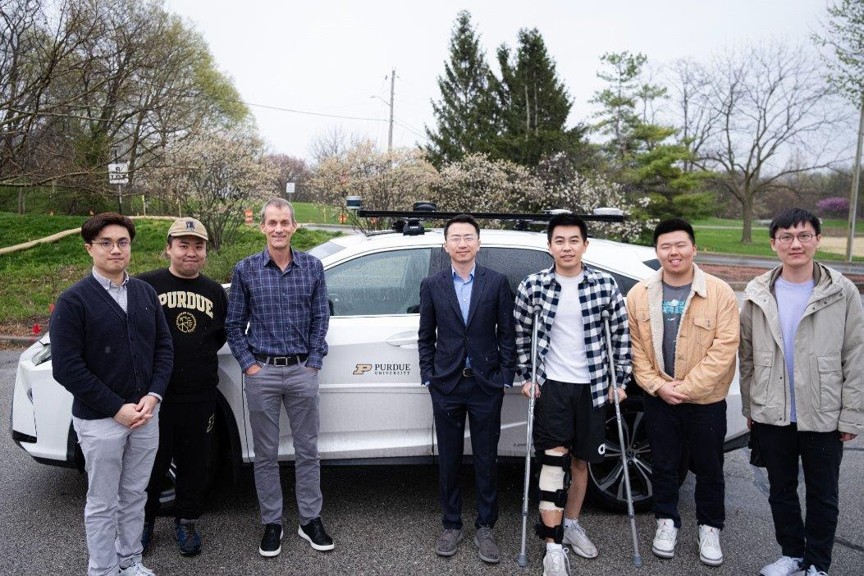
Photo credit: Ziran Wang/Purdue University, Lyles School of Civil Engineering
Purdue University researcher Ziran Wang has received the prestigious National Science Foundation (NSF) Career Award. The award, ‘CAREER: Vehicle Adaptive Shared Control: Predicting Human Driver Cognitive and Intent States for Personalized Control Decisions by Automated Vehicles‘, will support the development of artificial intelligence (AI) systems that enable automated vehicles to understand human attention, intent, and cognitive state, creating personalized shared-control systems that improve safety, build trust, and enhance the driving experience.
The NSF-funded research builds on a strong foundation established through CCAT-supported projects at Purdue. Wang’s earlier CCAT research, ‘CAV Pilot Development and Deployment in Midwest Winter‘, demonstrated how vision-language models can improve autonomous vehicle performance in challenging winter conditions by interpreting complex driving environments and adapting to driver preferences. His current CCAT project, ‘Safe and Personalized Control of Autonomous Vehicles with On-Board Vision Language Models‘, extends that work by developing lightweight, onboard AI systems capable of delivering safe, personalized automated driving in real-world conditions.
The progression from CCAT-funded research to a nationally recognized NSF CAREER Award highlights the program’s role in supporting innovative transportation research with real-world impact. By helping researchers explore emerging concepts, CCAT continues to accelerate work that improves the safety, reliability, and public acceptance of connected and automated transportation technologies.
Ziran is the twelfth CCAT principal investigator to receive the NSF CAREER Award. Past awardees include Yiheng Feng, Xiaopeng Li, Z. Morley Mao, Neda Masoud, Carol Menassa, Hadi Meidani, Gabor Orosz, Yanfeng Ouyang, Rajesh Rajamani, Amanda Stathopoulos, and Shreyas Sundaram.
This story was written by Calvin Tuttle of the Center for Connected and Automated Transportation (CCAT).