
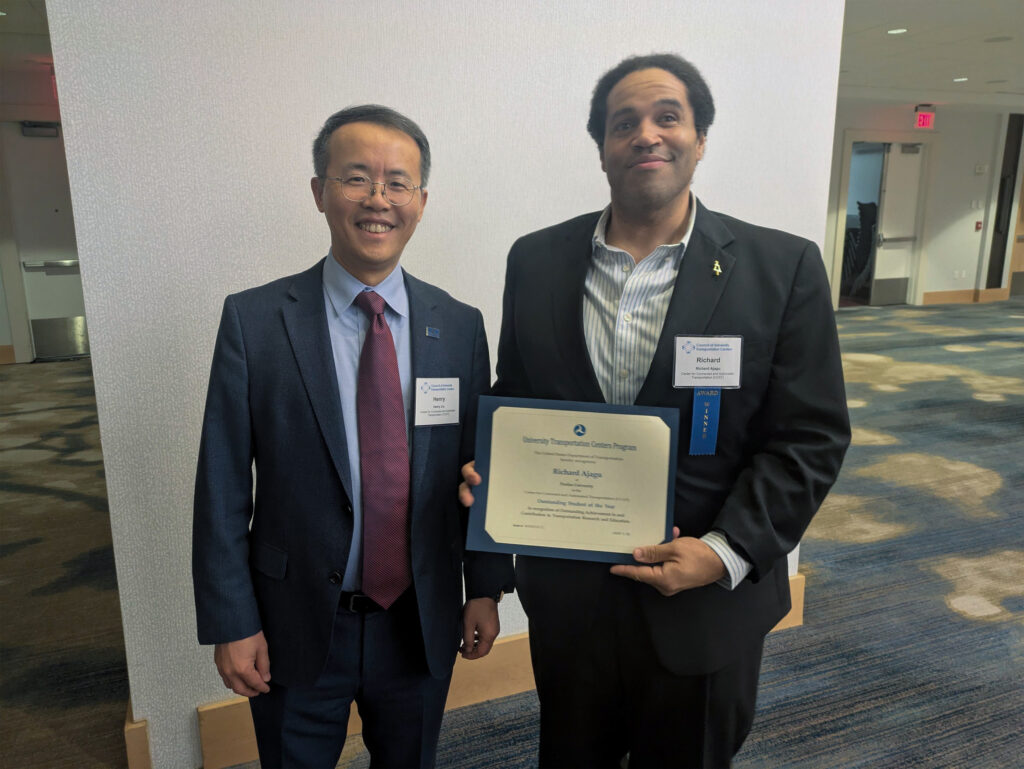
Richard Ajagu Receives Outstanding Student of the Year Award (SOYA) for 2026
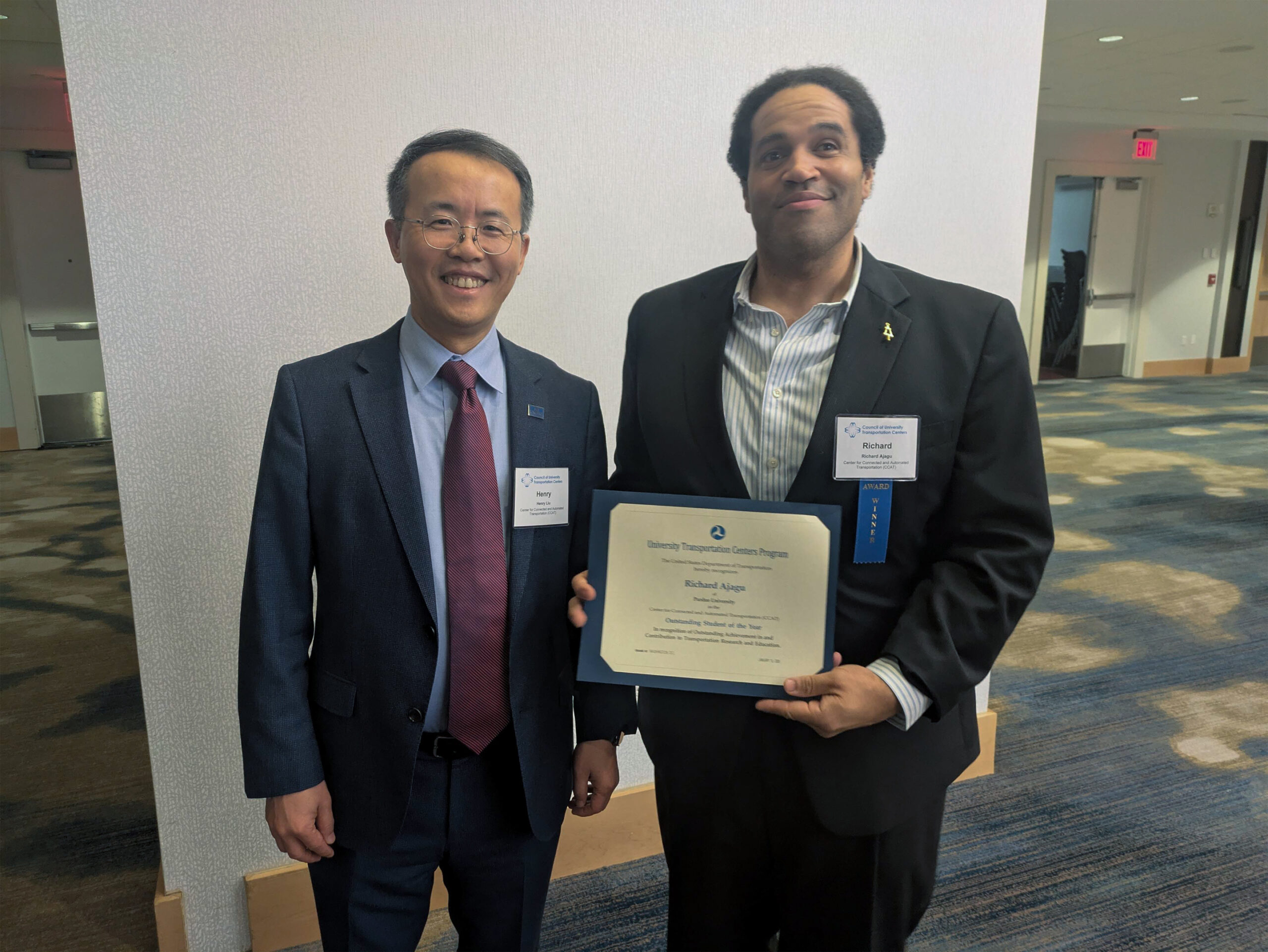
Photo credit: Calvin Tuttle/University of Michigan, College of Engineering, UMTRI
Every year, each USDOT-funded University Transportation Center (UTC) selects a Student of the Year, who is awarded at the Council of University Transportation Centers (CUTC) Winter Banquet in January. Selected students receive flight and hotel accommodations in D.C., as well as registration for the Transportation Research Board’s annual meeting. This year, the Center for Connected and Automated Transportation has nominated Richard Ajagu, a master’s student at Purdue University. Richard is advised by Professor Samuel Labi. He joined the program following his degree in Economics from the Krannert School of Management at Purdue University. He has worked on the following CCAT-funded projects:
- Economical Acquisition of Intersection Data to Facilitate CAV Operations Phase II – Implementation
- Lessons from High-speed Level-5 AV Racing
Richard met with CCAT Communications Director Calvin Tuttle to discuss his research and nomination.
Calvin: Can you tell us about your research here at Purdue University?
Richard: My research at Purdue is centered around different aspects of emerging systems, specifically the complex challenges of integrating autonomous systems into public life with a focus on developing adaptive strategies for the era of mixed-fleet mobility. This involves the exploration, stress-testing and development of cyber-physical autonomous systems themselves via autonomous racing, but also touching human-machine interaction with economic, safety and policy implications as we bring automation into public spaces. I am a member of Purdue AI Racing, an interdisciplinary team of grad researchers who compete in the Indy Autonomous Challenge, racing full-sized race cars on track against university teams from across the globe. In addition to autonomous racing, my most recent work has been on embedded systems and IoT to develop a solution to bring some smart-city technologies (based around intersection safety and monitoring) to smaller markets who just can’t afford the latest upgrades to infrastructure. This “Economic Acquisition of Intersection Data to Facilitate CAV Operations” became our Affordable Connected and Cyber-Secure Engineering for Smart Signals, or ACCESS System, created to bring real-time traffic signal data to connected vehicles, mobile devices, and traffic management centers at around 100x cost savings of the current CV2X ways of doing it. We’ve successfully field validated the bones of the system in Michigan, are in process of farther securing and scaling the network, bringing in a novel systems-engineering design methodology to make this possible. We hope this can help more small towns get a boost in modernization and developing smart city technologies, as a first stage to build off of in the future.
Calvin: Where did you grow up?
Richard: I grew up in a sleepy little San Francisco Bay Area suburban college town called Palo Alto; although I guess it’s a lot less sleepy these days.
Calvin: Do you have any hobbies outside of transportation research?
Richard: Threefold: I enjoy all things active; I’ve played sports my whole life. Another love is Music, writing and singing and appreciating the emotions or nostalgia which can be elicited through sound . Finally, I love exploring cultures, absorbing the different mindsets and perspectives, learning what I can from alternate realities.
Calvin: Is there a single moment that led you on the path to transportation engineering?
Richard: Looking back, there is no single moment; I’ve always been steeped in academia, with both my parents holding advanced degrees. My dad is an engineer (Mechanical), but my undergraduate pursuits were Economics and Physics. I’ve always been intellectually curious and loved the search for understanding; Engineering allows for development to put knowledge into action and develop solutions to societal problems. Transportation Engineering itself touches life so broadly, it instantly fascinated me when I started working with our CCAT lab.
Calvin: What role are you currently playing in CCAT research?
Richard: Here at CCAT, I am currently working to refine the ACCESS system using systems engineering methodology and exploring tech transfer options. I am also involved in experimenting with physical AI in Transportation, using autonomous racing as a testbed for understanding and testing edge-cases to refine technology and inform Policy.
Calvin: What activities are you currently participating in that advance CCAT’s efforts in education, outreach, training, and workforce development?
Richard: We are developing and teaching a couple of undergraduate project-based active-learning courses (ARES, AMP/AIMM), focusing on research and development around autonomous vehicular systems, in multiple domains. We have teams of students working on projects from autonomous boats, self-driving cars, to drone racing. I’m also the graduate mentor for Autonomous Motorsports Purdue, an undergraduate team centered around autonomous go-kart racing. Finally, along those lines I’m working with the Autonomous Karting Series (AKS) to organize and put on a Robotics and Racing event at Purdue this May, where undergraduate teams who have spent the year building their karts will spend a week at the University to validate and test their platforms on our race track, culminating with a day of racing for the top performers (Purdue Autonomous Grand Prix / AKS National Finals) and a final day of research symposium where these student teams will have an opportunity to present their past year of engineering research to industry representatives, academic officials, local high-school students, and members of the public.
Calvin: What accomplishment from the past year are you most proud of?
Richard: I’d say the success of putting together and instructing the first semester of our class. It was so great to see the students’ growing week by week and the formal presentations of their work at the end of the term. I’d also say I’m proud of our development of ARES Lab where we won a grant and are building physical small-scale platforms to study cooperative and adversarial autonomous driving.
Calvin: What plans do you have after finishing your Master’s?
Richard: My plans are multifaceted! I plan to continue research back on the West Coast either with a private lab or within academia, likely in a complex systems area like Game Theoretic Planning under Uncertainty or Systems of Systems. I’m also quite interested in policy consulting, working with government to understand and approach complex issues facing society with emerging technologies in domains like Physical AI, Automation, alternative fuels, and of course, Transportation. Lastly, I want to be working to develop curricula and educational practices to help students of all ages approach Systems Thinking and Complexity.
Calvin: Do you have any advice for students who are entering the program and working with University Transportation Centers (UTC) such as CCAT?
Richard: Get out of your comfort zone. Branch out, meet people, collaborate. The future is interdisciplinary! Remember- the purpose is to benefit society.